






Technopedia Center
PMB University Brochure
Faculty of Engineering and Computer Science
S1 Informatics S1 Information Systems S1 Information Technology S1 Computer Engineering S1 Electrical Engineering S1 Civil Engineering

faculty of Economics and Business
S1 Management S1 Accountancy

Faculty of Letters and Educational Sciences
S1 English literature S1 English language education S1 Mathematics education S1 Sports Education
teknopedia

teknopedia

teknopedia

teknopedia

teknopedia

teknopedia
teknopedia
teknopedia
teknopedia
teknopedia
teknopedia
  • Registerasi
  • Brosur UTI
  • Kip Scholarship Information
  • Performance
  1. Weltenzyklopädie
  2. Weighted fair queueing - Teknopedia
Weighted fair queueing - Teknopedia

Il weighted fair queueing (WFQ, "accodamento equo pesato")[1] è un algoritmo di scheduling.

Funzionamento

[modifica | modifica wikitesto]

WFQ è una generalizzazione del fair queuing (FQ, "accodamento equo"). Sia nel WFQ che nel FQ, ogni classe ha un rispettivo flusso di dati FIFO. Nel fair queuing, con una velocità di trasmissione R {\displaystyle R} {\displaystyle R} e con N {\displaystyle N} {\displaystyle N} flussi di dati serviti simultaneamente, ogni flusso avrà un rate di R / N {\displaystyle R/N} {\displaystyle R/N}.

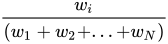
Nel WFQ, invece, i pacchetti in arrivo vengono smistati e accodati in classi di peso differente w i {\displaystyle w_{i}} {\displaystyle w_{i}}. Pertanto, ogni flusso in un determinato intervallo di tempo avrà una frazione di servizio di[1]

w i ( w 1 + w 2 + . . . + w N ) {\displaystyle {\frac {w_{i}}{(w_{1}+w_{2}+...+w_{N})}}} {\displaystyle {\frac {w_{i}}{(w_{1}+w_{2}+...+w_{N})}}}

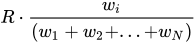
Data una banda R {\displaystyle R} {\displaystyle R}, ogni coda i {\displaystyle i} {\displaystyle i} avrà sempre un throughput di[1]

R ⋅ w i ( w 1 + w 2 + . . . + w N ) {\displaystyle R\cdot {\frac {w_{i}}{(w_{1}+w_{2}+...+w_{N})}}} {\displaystyle R\cdot {\frac {w_{i}}{(w_{1}+w_{2}+...+w_{N})}}}

L'algoritmo è stato proposto per la prima volta nel 1989.[2][3]

Note

[modifica | modifica wikitesto]
  1. 1 2 3 Kurose-Ross, p. 549.
  2. ↑ (EN) A. K. Parekh e R. G. Gallager, A generalized processor sharing approach to flow control in integrated services networks: The single-node case (PDF), in IEEE/ACM Transactions on Networking, vol. 1, n. 3, 1993, p. 344, DOI:10.1109/90.234856.
  3. ↑ (EN) A. Demers, S. Keshav e S. Shenker, Analysis and simulation of a fair queueing algorithm, in ACM SIGCOMM Computer Communication Review, vol. 19, n. 4, 1989, p. 1, DOI:10.1145/75247.75248.

Bibliografia

[modifica | modifica wikitesto]
  • James F. Kurose, Keith W. Ross, Internet e reti di calcolatori, 2ª ed., Milano, McGraw-Hill, 2003, ISBN 88-386-6109-X.

Voci correlate

[modifica | modifica wikitesto]
  • Scheduler
  • Deficit round robin
  • Weighted round robin
  • Fair queuing
  Portale Informatica: accedi alle voci di Teknopedia che trattano di informatica
Estratto da "https://it.wikipedia.org/w/index.php?title=Weighted_fair_queueing&oldid=121931043"

  • Indonesia
  • English
  • Français
  • 日本語
  • Deutsch
  • Italiano
  • Español
  • Русский
  • فارسی
  • Polski
  • 中文
  • Nederlands
  • Português
  • العربية
Pusat Layanan

UNIVERSITAS TEKNOKRAT INDONESIA | ASEAN's Best Private University
Jl. ZA. Pagar Alam No.9 -11, Labuhan Ratu, Kec. Kedaton, Kota Bandar Lampung, Lampung 35132
Phone: (0721) 702022